
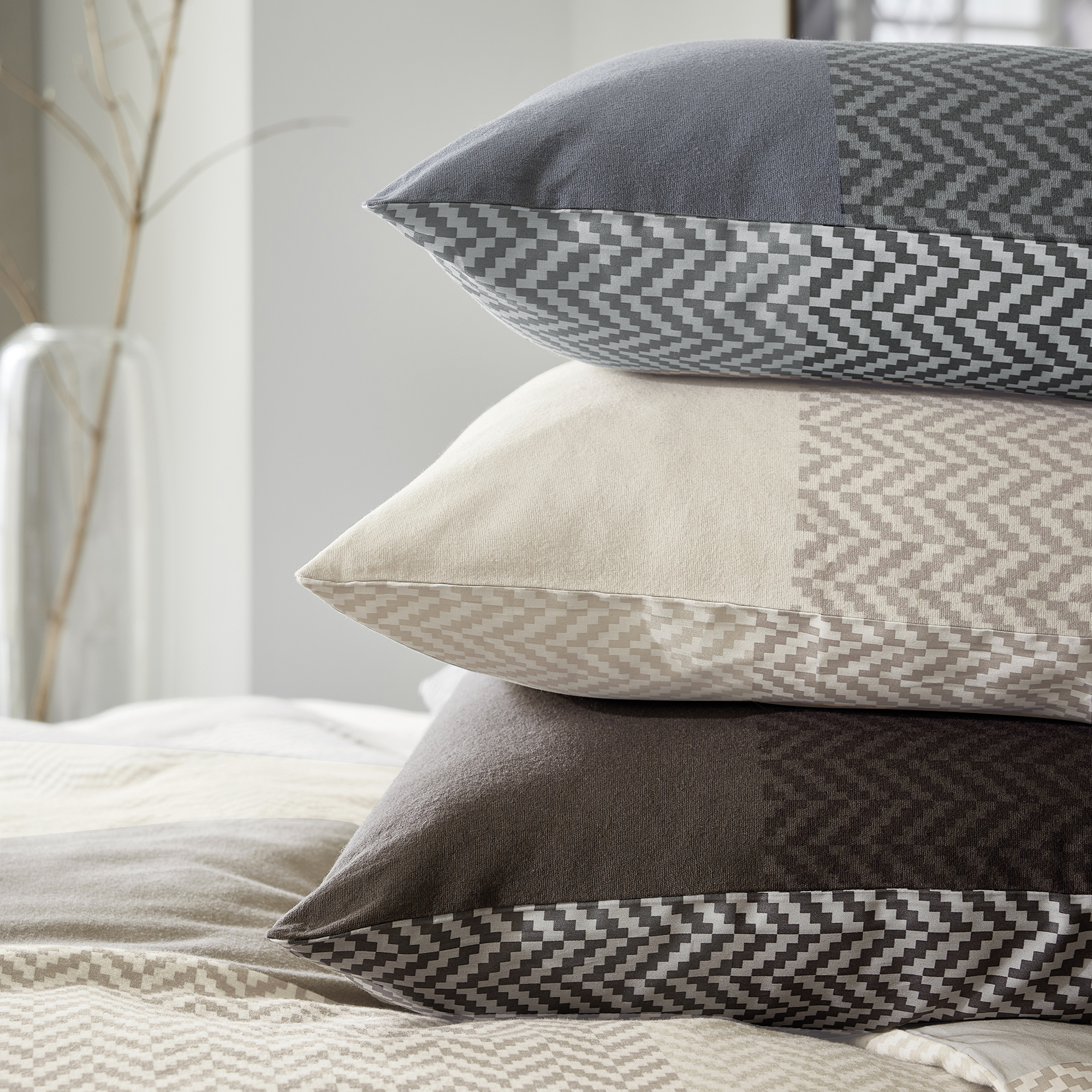

A thread that hasn’t broken for 200 years
We take you on a journey through time – and for each year there is the matching IBENA blanket.

The Beginning
A bold step in uncertain times
In 1826, peace had finally returned, but the world had changed, and people were searching for new anchors amid uncertainty. In this time of contrasts, Josef Philipp Beckmann founded his textile trading business “J. Beckmann” in Wesel and quickly opened up new markets for his linen and cotton fabrics. He spun the first thread of a story that would endure for two hundred years.
Read moreShop the anniversary blanket


Hunger & Hope
When hunger became the voice of the people
The 1840s were a time of simmering unrest: poor harvests drove food prices up, many families slipped into poverty, and hunger shaped everyday life. On June 3, 1844, the hardship erupted in Peterswaldau; by June 6 the uprising had ended in bloodshed, and 1846 became the year of the last great famine. These years also marked decisive choices for the Beckmann family: in 1844, Josef Philipp Beckmann and his brother Franz sold the estate in Krechting, thereby ending the last tie to their ancestral location.
Read moreShop the anniversary blanket


Full Steam Ahead
Progress as a new way of life
The American Civil War broke out in 1861 and ended four years later with the abolition of slavery in the United States and the restoration of the Union; because the Southern states could hardly export any cotton, a severe cotton shortage arose in Europe, and the price per kilogram of cotton rose from 94 pfennigs to 8.62 marks. On May 7, 1862, Josef Philipp Beckmann and his brother Franz combined their efforts into a joint company, and in 1866 the application for a second steam boiler set the course for further growth. On January 21, 1867, Josef Philipp Beckmann handed over the company to his sons Heinrich and Albert, and on April 20, 1871, the brothers Heinrich and Albert signed the partnership agreement: “J. Beckmann” remained a family business.
Read moreShop the anniversary blanket


Spirit of Innovation
The future begins
The 1880s were an era of contrasts: while Historicism celebrated a return to magnificent design with Neo-Baroque, technological and social progress was simultaneously gaining momentum. In 1886, Carl Benz received the patent for his motor car, and in the same year Albert Beckmann demonstrated social responsibility; just one year later, Heinrich’s sons Albert and Ludwig founded the company “Heinrich Beckmann Söhne.” The mysterious death of King Ludwig II in 1886 marked a turning point, and the Year of the Three Emperors in 1888 brought Wilhelm II to the throne.
Read moreShop the anniversary blanket


Times of Change
Society in transition
Planck’s quantum formula (1900), Freud’s psychoanalysis (1901), and Einstein’s theory of relativity (1905) transformed the understanding of humanity, space, and time, and with the German Civil Code (1900) and the Child Protection Act (1904), a unified legal framework was established. Between 1900 and 1905, a severe economic crisis forced many businesses to their knees, but from 1905 onward Jacquard blankets were exported to England, ponchos were delivered to South America, and fringed blankets and shawls were shipped as far as British India. In 1908, Albert Beckmann officially transferred responsibility to his nephew and granted him power of attorney.
Read moreShop the anniversary blanket


New Objectivity
Between hyperinflation and hope for stability
The occupation of the Ruhr in 1923 and the following hyperinflation plunged Germany into a deep crisis. Only with the introduction of the Rentenmark in November 1923 and the Dawes Plan of 1924 did new hope begin to emerge. On January 1, 1925, Josef Beckmann took over the management of “J. Beckmann Nachfolger,” and in 1926 the company was registered as a limited partnership. The purchase of the Baldus factory on Teutonenstraße, the modernization of the machinery, and the construction of a new weaving hall were intended to provide new momentum. However, the global economic crisis began in 1929 and once again presented the Beckmann family with major challenges.
Read moreShop the anniversary blanket


Reconstruction
When dreams rose again from the ruins
After 1945, smoking ruins remained, housing was scarce, hunger prevailed, and the turn of the year 1946/47 became remembered as the “Hunger Winter.” As early as November 1945, a small weaving mill with twelve looms at J. Beckmann Nachfolger resumed work; in 1946 there were 36, in 1948 around 159, and by 1949 finally 237 machines. At H. Beckmann Söhne, operations restarted in July 1947; on May 1, 1947, Max Wagner joined as the first external managing director, and by the end of 1946 the first signs of the economic miracle were already becoming visible.
Read moreShop the anniversary blanket


Celebrations
From anniversary to merger
In the 1960s, the blanket became more than just a household item: fashionable designs turned it into a statement piece, and with the newly introduced transparent packaging, IBENA became a pioneer in product presentation. Technical modernization was consistently driven forward, automatic looms increased efficiency, and the first electronic data processing system (Hollerith punch cards) marked IBENA’s entry into the digital age. The decisive milestone followed in 1968: the merger of IBENA with H. Beckmann Söhne to form IBENA Vereinigte Textilwerke GmbH & Co. A new building was constructed on Teutonenstraße and production was reorganized.
Read moreShop the anniversary blanket


Electronic Age
Digitalization and new construction
In the 1980s, IBENA strategically repositioned itself and accelerated the development of technical textiles, and with the EDV systems Loomdata and TEXIS, digitalization entered production. From 1985 onward, the US dollar lost value dramatically, and as a consequence the finishing and manufacturing facility in Spartanburg, South Carolina had to close in 1990. In 1988, IBENA made the groundbreaking decision to build a completely new production site in Rhede and sold the former location on Teutonenstraße to Johann Borgers KG.
Read moreShop the anniversary blanket


Fragile
A changing world
The 2000s were a decade of upheaval: globalization and digitalization transformed the economy and society, and the terrorist attacks of September 11, 2001 had worldwide economic consequences. From 2000 onward, the company expanded its portfolio through licenses for home textiles from the brands s.Oliver and bugatti, and in 2002 IBENA expanded its production network by starting manufacturing in Litvínov. In 2006, IBENA had to file for insolvency, but the takeover by the Daun textile group from Rastede enabled a fresh start, and with Elégance as well as a successful cooperation for Rosamunde Pilcher home textiles, the company sharpened its profile.
Read moreShop the anniversary blanket


Tradition with a vision for the future
200 years of textile passion
The year 2026 is a special one: IBENA celebrates its 200th anniversary – two centuries full of change, crises, and new beginnings – proving that tradition and innovation are not opposites. Since 2020, the world has been in an exceptional state, and two years earlier the long-established company had already boldly embraced e-commerce, placing IBENA exactly where people were looking for blankets and bedding – online. The passing of Josef Albert Beckmann on June 4, 2022 left a great void, but 2026 is ultimately a year of celebration: 200 years of textile passion, since 1826.
Read moreShop the anniversary blanket